When a Garment Breaks, the Real Design Begins
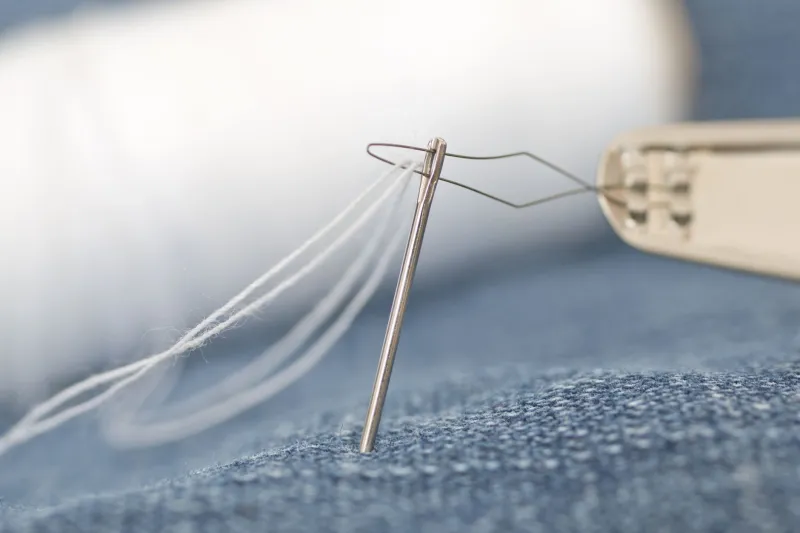
There is a particular kind of courage required to wear a garment that has been visibly repaired. In a culture conditioned to treat wear and tear as evidence of inadequacy — and to replace rather than restore — choosing to mend is, quietly, a radical act. It is also, at Sharon Ky Kim Designs, a deeply familiar one.
The philosophy behind every collection on this site begins with intention: the deliberate selection of materials, the considered placement of a seam, the choice of a silhouette that serves the body rather than simply adorning it. But intention does not end at the point of purchase. It continues into the life the garment lives — and what happens when that life leaves its mark.
The Shift Toward Visible Repair
Across the United States, a quiet but growing movement has taken hold in closets, community sewing circles, and independent studios alike. Visible mending — the practice of repairing garments in ways that acknowledge rather than disguise the repair — has moved from niche craft revival into genuine cultural conversation.
The Japanese technique of sashiko, a form of running stitch traditionally used to reinforce fabric in working garments, has found a devoted following among American sewists who appreciate both its geometric beauty and its functional heritage. Darning, once associated with frugality or necessity, is now practiced as a meditative art form, with enthusiasts using contrasting yarns to transform a worn elbow or thinning heel into something worth examining closely. Patches — long a symbol of counterculture or childhood — have re-entered the wardrobe as deliberate design choices, placed with the same care a designer gives to a pocket or a buttonhole.
What unites these practices is not nostalgia. It is a refusal to treat clothing as disposable.
What Repair Reveals About Value
When a garment is mended — particularly when it is mended visibly — it communicates something that a new garment cannot: that the person wearing it decided this piece was worth the effort of continuation. That is a statement about value that no price tag can replicate.
At Sharon Ky Kim Designs, this understanding shapes the way collections are conceived from the very beginning. Garments built with honest construction — where quality materials meet considered technique — are precisely the garments worth repairing. A piece designed with integrity ages differently than one designed for immediacy. Its fibers hold. Its structure invites intervention rather than resisting it. When a seam eventually loosens or a fabric softens at a point of repeated contact, the response is not crisis. It is conversation.
Repair, in this context, is not a concession to imperfection. It is an extension of the original design dialogue.
The Aesthetics of Honesty
There is a Japanese concept — wabi-sabi — that finds beauty in impermanence and imperfection. While the visible mending movement in the United States does not always invoke this term explicitly, the underlying sensibility is recognizable. A garment that has been darned with a contrasting thread, or reinforced with a hand-stitched patch in a complementary fabric, carries visual information that a pristine piece does not. It has a history. It has been somewhere. It has been chosen, again.
This is not an argument for manufactured distress or artificially aged denim produced in bulk. The distinction matters enormously. Authentic mending is earned. The worn knee on a pair of trousers that has since been reinforced with careful stitching represents actual time, actual use, actual living. That authenticity is precisely what visible repair celebrates — and what mass-produced approximations of it cannot replicate.
For those building a wardrobe around Sharon Ky Kim's collections, this principle extends naturally into how each piece is cared for over time. A garment worth selecting with care is a garment worth tending with care.
Mending as Sustainable Practice
The environmental argument for repair is, by now, well-documented. The American fashion industry generates an estimated 11.3 million tons of textile waste annually, a figure that reflects not only overproduction but a cultural habit of discarding rather than maintaining. Choosing to mend a garment instead of replacing it is one of the most direct interventions an individual can make within that system.
But sustainability, as Sharon Ky Kim's design philosophy insists, is not only an environmental position. It is an aesthetic one. A wardrobe built on quality and maintained through care produces a different relationship with clothing than one built on volume and governed by trend cycles. The former requires less. It asks more of each piece — and in doing so, creates the conditions under which mending becomes not only practical but meaningful.
When you repair a garment you love, you are also repairing your relationship with the way you consume. That is a design statement of considerable weight.
Beginning Your Own Mending Practice
For those new to intentional repair, the entry point need not be elaborate. A basic darning mushroom, a selection of quality threads in both matching and contrasting tones, and a willingness to proceed slowly are sufficient to begin. Sashiko kits designed for beginners are widely available through independent craft suppliers, and the running stitch at its foundation is among the most accessible in the sewing canon.
The more important shift is perceptual. Before reaching for a replacement, pause with the garment that needs attention. Examine where it has worn. Consider what that pattern of use reveals — about how you move, which pieces you reach for most, what your body asks of your clothes. Then consider what a repair might look like that honors both the garment's original design and the life it has lived inside your wardrobe.
At Sharon Ky Kim Designs, the belief is that clothing carries meaning far beyond its first wearing. The stitches added in repair are not corrections. They are continuations — evidence that what was made with intention was also received with intention, and that the conversation between designer and wearer did not end at the point of sale.
A garment repaired with care is a garment that has been truly worn. And that, ultimately, is the purpose of wearable art: not to be preserved untouched, but to be lived in fully — and tended, honestly, along the way.