The Quiet Detail That Separates Thoughtful Design from Throwaway Fashion
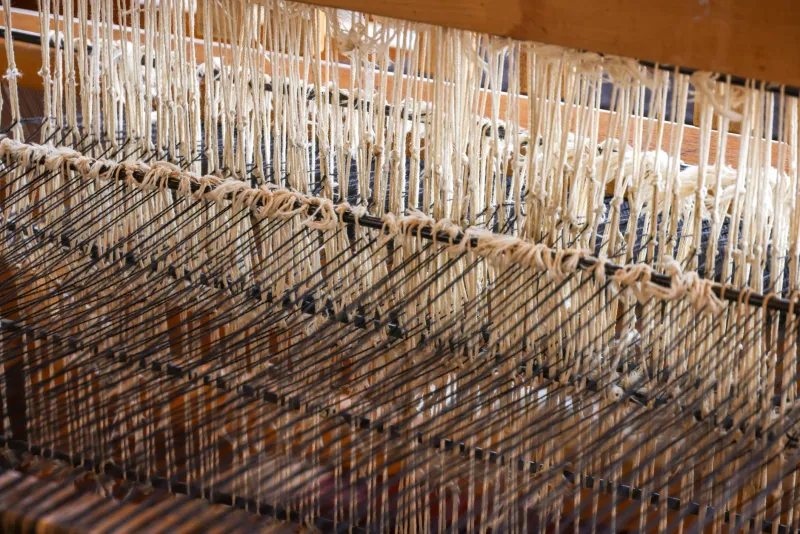
There is a language embedded in the margins of cloth. It does not announce itself. It does not appear on a hang tag or a brand's social media feed. It exists at the very edge of a woven fabric — a narrow, self-finished border produced as the loom completes each pass of thread. Textile workers call it the selvedge, derived from the phrase self-edge, and for centuries it served as both a structural necessity and an informal signature of a mill's quality standards.
Today, in an industry dominated by speed and volume, the selvedge has become something more: a quiet test of a designer's values.
What the Selvedge Actually Is
When fabric is produced on a loom, the weft threads — those running horizontally across the cloth — must turn back on themselves at each side to continue weaving. The edges where this turning occurs naturally form a tighter, more densely woven border than the fabric's interior. This border does not fray. It does not require additional finishing. It arrives complete.
On a traditional shuttle loom, the selvedge is narrow, clean, and often bears identifying information: the mill's name, the fiber content, the colorway number, or simply a stripe of color that distinguishes it from the body of the fabric. On wider industrial looms designed for mass output, the selvedge is frequently cut away immediately, treated as an inconvenient byproduct rather than a functional asset.
That choice — to cut or to keep, to waste or to honor — reveals far more about a designer's philosophy than any marketing language ever could.
Why Most of the Industry Ignores It
High-volume fashion production operates on a logic of throughput. The faster a bolt of fabric moves from delivery to cutting table to sewing floor, the lower the unit cost. Selvedge edges, in that model, represent a complication. They require the pattern cutter to work around them, to account for slight variations in edge density, to slow down long enough to ask whether this border might serve a structural or aesthetic purpose in the finished piece.
Most production pipelines are not designed to ask that question.
The result is that enormous quantities of selvedge — already finished, already stable, already beautiful in its own spare way — are discarded before a single seam is sewn. In a domestic context, that might seem like a minor inefficiency. Across millions of garments produced annually, it represents a staggering accumulation of wasted material and wasted intention.
How Sharon Ky Kim Approaches the Edge
At Sharon Ky Kim Designs, the selvedge is not an afterthought. It is a starting point for conversation between the fabric and the design.
When working with woven textiles, the studio considers whether the selvedge edge can be incorporated directly into a seam allowance, used as a finished hem, or positioned as a visible design element along a cuff, a collar, or a side panel. This is not a decorative trick performed for novelty's sake. It is a recognition that the fabric arrives with its own integrity already intact — and that a designer's first responsibility is to honor what the material already knows how to do.
This approach also reflects a broader commitment to minimizing waste at every stage of the design process. When a selvedge edge is preserved rather than trimmed, even a fraction of an inch of usable fabric is recovered across the entire cut of a garment. Multiply that recovery across a collection, and the difference becomes meaningful — both materially and philosophically.
Reading the Selvedge as a Consumer
For someone shopping with intention, the selvedge offers a rare opportunity to assess a designer's relationship with their materials before a single stitch is examined.
If you have access to a garment's interior construction — turn it inside out, examine the seam allowances — look for whether the selvedge has been incorporated or simply cut away. A clean selvedge used as a seam allowance edge eliminates the need for serging or binding on that side. It is a sign that the cutter worked deliberately, aligning the pattern to take advantage of what the fabric naturally provides.
You may also find selvedge edges used as finished hems on lighter-weight garments, particularly along sleeve edges or the lower hem of a tunic or blouse. When this is done well, it is nearly invisible from the outside — a seamless conclusion to the fabric's journey from loom to body. When you notice it, you are seeing evidence of a designer who studied the cloth before they cut it.
In denim specifically, selvedge fabric has become a recognized marker of quality among American workwear enthusiasts and heritage clothing collectors. Selvedge denim, woven on narrow shuttle looms, produces a tighter, denser weave than its open-end spun counterpart, and the characteristic clean edge is often left visible at the outseam of a pair of jeans as a deliberate signal of provenance. The same principle — using the edge as evidence of quality — applies across all woven textiles, not just denim.
The Larger Philosophy Behind the Margin
Paying attention to the selvedge is ultimately an exercise in a particular kind of seeing. It trains the eye to look past the surface of a garment — past the silhouette, the color, the drape — and into the decisions that shaped it before it ever became clothing.
Every bolt of fabric has a history. It was grown or synthesized, processed, dyed, and woven by people and machines operating within specific conditions and constraints. By the time it reaches a design studio, it carries all of that history within its threads. A designer who respects the selvedge is, in a sense, acknowledging that history — recognizing that the fabric did not begin at the cutting table and that its integrity deserves to be carried forward into the finished piece.
This is the animating principle behind wearable art: that clothing is not merely assembled but composed, that every element of a garment reflects a choice, and that the most revealing choices are often the ones no one else is looking at.
The selvedge sits at the very edge of the cloth. It is easy to miss. But for a designer committed to intentional work, it is precisely where the real conversation begins.
Sharon Ky Kim Designs is a wearable art and fashion label dedicated to original design, thoughtful construction, and the belief that what you wear should mean something. Explore current collections at sharonkykimdesigns.com.